All telephones are available to buy by mail order
£15 post and packing to all parts of the UK.
Smaller parts post and packing is from £3.50 to UK only
You can collect from my shop at weekends by arrangement
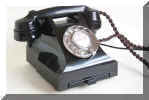
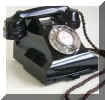
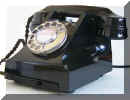
The popular 300 series bakelite telephone with its built
in bell, was the standard telephone issued by the GPO from 1937 to
1959.
It continued in production for export and private systems until the mid
1960's.
Historical Information
The self contained 332 bakelite telephone design by Ericsson of Beeston
Nottinghamshire, England, was first seen in this country in 1932.
A few were made for private systems, but the breakthrough came, when the
general design was adopted by the GPO in 1937 as a replacement for the 232.
Production ceased for The GPO in 1959, but continued for other customers until
the mid 1960's.
The GPO version incorporated the drawer in the base as used in the 232.
This was potentially a problem as papers in the drawer could
interfere with the bell mechanism. Towards the end of their life, the
drawers were routinely removed and replaced by a blank front.
In the fifties a mark 2 version was introduced with an improved dial,
and slightly modified internals and hand set.
As with the previous GPO telephones, a number of manufacturers made
these to a common design.
Indian 332
It is interesting to note that the Indian version by Indian Telephone
Industries of Bangalore, was still made until
quite recently. They are being imported into this country in large
numbers and are often passed off as British 332's. Externally they look much the same, but the
performance, internals and
quality of construction is
very inferior. I do not buy, sell, restore or maintain Indian
telephones.
There is some controversy, especially among enthusiasts as to whether or not
they are genuine or reproduction telephones. My view is that they are
reproduction as they are made in the style of a British 332. Very few of the
parts are interchangeable with those of a British 332. I also believe that it
was not the intention of Indian Telephone Industries to create a telephone that
would deceive the public here, but the desire to develop an inexpensive
telephone for their local market. Unfortunately, they are frequently passed off
as genuine British telephones on eBay and in many antique shops and antique
fairs. They obviously have a value in their own right, especially some of the
coloured examples which were made in colours and colour combinations unheard of
from British manufacturers.
An analogy would be that a genuine Chippendale chair is just that. A copy made
later could look almost identical but can only be classed as a reproduction as
it can never be the real thing.
Technical Information
The 332 was the successor to the telephone type 232 and bell set 26.
Electrically it was almost identical using many of the same parts. The
only difference was the addition of a 0.1 MFD capacitor in parallel with
the microphone to reduce the risk of radio interference.
The 2.0 MFD ringing capacitor was now connected to the rest of the telephone by very
short leads. This meant that its other function as part of a spark
quench circuit across dial pulse switch was more effective. This
lengthened the life of the dial and reduced interference to nearby radio
sets.
The improved case shape enabled other features such as 'Call Exchange'
button to be fitted. Up to 3 buttons and switches could be installed for
various models and systems.
A more versatile screw fixing terminal block was fitted inside.
The one piece Bakelite case was much more robust and cheaper to make
than the multipart 232.
The Mark 1 continued in production almost unchanged until the 1950's
when the Mark 2 was introduced. This had a roller bearing gravity switch
to alleviate the sticking problems of the previous model. A more
reliable type 12 trigger dial, which was less prone to stick, or
gradually run slow. A type 2P receiver and matching ear cap, was fitted which had
much better acoustic properties than the earlier 1L.
Those made for private systems, and those exported to Portugal were
mostly the Mark 1 type
Credit/Debit Cards are the
preferred method of payment.
I no longer accept cheques.
If you wish to place an order,
or have an enquiry, please read all below.
Please call me (Gavin Payne) by telephone if you wish to place
an order for a telephone, spare parts, or have an enquiry. I can usually
be reached 9.00am to 5.45pm any day, including weekends. Calls in the
evening are not appreciated and could make me very grumpy. The number is
01245 400601.
I am in the shop
most Saturday and Sunday mornings between 10.00 and 12.00. These are the
only times I am in the shop for the sale of spare parts, conversions and
repairs.
Conversions and repairs can often be carried out while you wait.
If you have a telephone that you want to know more about, or
have it
repaired or converted, please have it right next to you when you call.
Please also have a selection of small flat bladed screwdrivers to hand. I do not give advice for DIY repairs or conversions or valuations of any
kind over the telephone or by email. Please bring the telephone to my shop
for assessment, but always call me first before bringing it in.
Emails to
gp@theoldtelephone.co.uk or copy and paste gp@theoldtelephone.co.uk into
your email programme or app .
By post to
The Old Telephone Company, The Old Granary, Battlesbridge
Antiques Centre,
Battlesbridge, Essex SS11 7RE.

 Ring back memories
with
Ring back memories
with

 an old Bakelite
telephone
an old Bakelite
telephone


 I no longer accept cheques.